Caralina Lawless and Sylke Lesinski
 |
| Pericles, Prince of Tyre 1609 Title Page |
Pericles, Prince of Tyre, is a play
detailing the story of the fictional prince Pericles and his adventures along
the Mediterranean. It was inspired primarily by the story of Apollonius of Tyre,
an old Greek Romance translated by John Gower, who narrates the Shakespeare version of the play. It also
drew inspiration from The Patterne of
Painefull Adventures, a work written by Lawrence Twine produced in 1576, which saw a renewal in popularity when it was reprinted in 1607. Although the
question of Pericles’ authorship has long been debated, it wasn’t until 1919
after the publication of H. Dugdale Sykes that George Wilkins was widely
accepted to have co-authored the play with the Bard. The play was partially written by William
Shakespeare, and partially by George Wilkins, as co-authoring was a fairly
common practice at this time. It was most likely written between 1606-1608, as
that was when George Wilkins was most active as a writer. It was around this time that a Venetian ambassador to
England named Zorzi Giusinian saw a play called Pericles in London, which ran
from January 5th 1606 to November 23 1608, though there is some
speculation as to whether this was the Shakespeare version, or a different version of the play altogether.
The play was first published in 1609 in a quarto edition, likely a pirated
version.
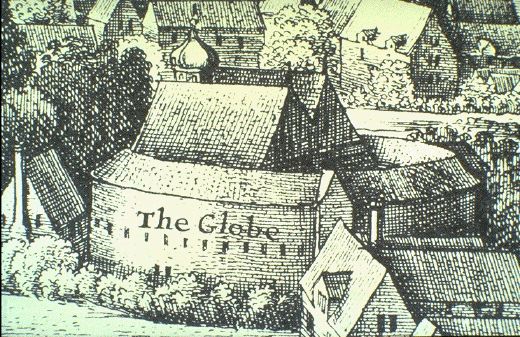 |
| The Old Globe Theatre, London, 1642 |
Though the title page of the first
quarto states that it had been put on many times before 1609 at the Old Globe
theater, the first confirmed production of Pericles was in May 1619, in the
“King’s great chamber” in Whitehall. The Kings Men performed Pericles numerous
times thereafter at the Old Globe between 1625 to1631. While it does not appear
in the First Folio in 1623, it was published in quarto form in 1609, 1611,
1619, 1630, and 1635, before being added to the Third Folio in 1663.
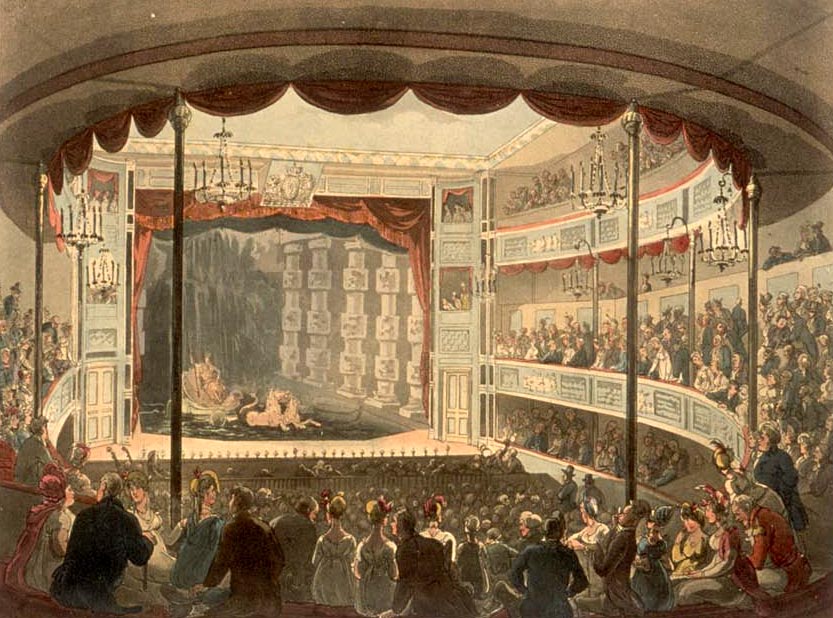 |
| Sadler Wells Theatre, Clerkenwell, c. 1808 |
There is little evidence of a
performance again until John Rhodes’ staging of it in 1660, at the start of the
Restoration. Thomas Betterton played the title role at the Cockpit Theater, as
the first production of any of Shakespeare’s works in the new era. However, the
play is difficult to perform, and with the changing values of the Restoration
period, the play’s structure did not fit the new neoclassical formats. Critics of the time generally disliked the
play, and scholar Edward Dowden cited it as being “as a whole singularly
undramatic” and that it “entirely lacks unity of action”. Thus, it seems to
have vanished from performance afterwards until 1854, with Samuel Phelps' staging of the
play at the Sadler Wells Theatre in Clerkenwell, though not without heavy edits
to fit the Victorian ideals.
The play seems to disappear from
view once more until the 1929 production by Walter Nugent Monck at the
Maddermarket Theatre in Norwich, though again, cuts were made, most notably in
the first act regarding the incest between King Antiochus and his daughter. It
seems that as the play moved through time, time moved with the play, making
adjustment where necessary, and editing scenes to fit the values and the ideals
of the age in which it was performed.
In contrast to its previous scalding
reviews, the production of Pericles at the Theatre for a New Audience was
recently praised by the New Yorker as being “Sweeping, majestic…magical,
theatrical…with music, dance, and pageantry all contributing to the glow.” Despite
its rocky history, its content, and the difficulty of its staging, Pericles,
Prince of Tyre went on to rise in popularity and success, eventually becoming
one of Shakespeare’s better known plays.
